


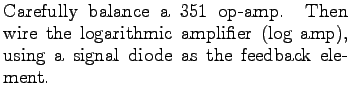
Using a non-linear feedback element with an op-amp (e.g. a pn-junction diode) produces startlingly different transfer functions. Logarithmic amplifiers serve as the basis for circuits such as analog multipliers studied in Section 4.6.
![$\textstyle \parbox{2.0in}{\raisebox{-1.25in}{\par
\hbox{\hskip 0in \vbox to 1.25in{\includegraphics[height=1.25in]{FIGS/fig4.7.ps}\vfill}}}}$](img98.png)
 as a function of
  and
and  :
:
|
|
 |
|
| 10.0mV | 1M |
||
| 10.0mV | 100k |
||
| 100.0mV | 100k |
||
| 1.0V | 100k |
||
| 10.0V | 100k |
||
| 10.0V | 10k |
 vs. .
vs. .
For all but very small forward bias voltages, the current through a diode varies
exponentially with the applied voltage:
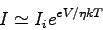
 is an empirical parameter (
 for Si, 1 for Ge diodes), and
 is the intrinsic current at zero bias.
Apply circuit analysis (Simpson, Sec. 9.7) to your logarithmic amplifier
and verify that the same
relationship holds for the measured and .
Fit your data to the above equation and determine the parameters and
for your diode. Can you tell if this is a Si or a Ge diode?
For info, write to: [email protected]